


Ash Wed February 14, 2024
Ash Wed
February 14, 2024
Today we begin the season of Lent. For the next 40 days we will prepare for Easter with Prayer, Fasting and Almsgiving. This year Ash Wednesday falls on Valentines Day.
For me Valentine’s Day is about “conversation Hearts” The hard candies have saying about love and loving. Often, we associate the love we share with one special person, as we begin Lent these “conversation Heart” messages can be used to remind us to love our brothers and sisters as created in the image and likeness of God.
Let us look at some of the phrases found on these candies.
• Cutie: When we see others through the eyes of God we see their Beauty.
• Sexy: Sexy is not simply about the physical act of love. We can see the other as sexy when we choose to love them.
• Be Mine: This is what our God says to us each day. How well have you listened for God’s voice?
• Angel: Those who give with generosity are often called angels. How have you been an angel in the past? How can you be and angel in the future?
• Beautiful: How do we look at others? Do we see their innate beauty?
• XOXO: Hugs and Kisses, have you hugged or kissed anyone lately?
• Text Me: Have you been out of touch with someone you need to reach out to this Lent?
Valentine’s day and Lent are about improving our relationships. In this 40 day retreat the church suggests three practices to improve our relationship with our God and others, Prayer, Fasting and Almsgiving.
There are many prayer opportunities in this season. Check the weekly parish bulletin for more details. The Rice Bowl is a good tool for fasting and almsgiving. The money you save from the fasting you perform maybe placed in the Rice Bowl to be used by Catholic Relief Services to feed the needy in our world.
This season begins and ends with a celebration of Love. Today we honor the saint of love and at Easter we celebrate athe love of a God who suffered, died and rose for us.
May the risen Christ be with you as you journey though Lent to Easter.

We are on the cusp of Delaware County Fair week, and if you've ever been to that fair, you may be well familiar with one of its fixtures: the pancake tent run by a Walton community church. This past week, I was on the fairgrounds in my secular job capacity as Cooperative Extension educator, helping get our displays ready in the Agricultural Awareness area of the fair, which happens to be right next to the pancake tent. The church was also busy getting their tent set up as well. At one point I glanced over and realized that their pastor was leading a small group in a Bible study, while others continued to set up their serving area and kitchen. How nice, I thought, that they made space for this in the busy-ness of their set up. We went about our tasks, while this small group immersed themselves in Scripture. At some point, I realized that I was hearing the pastor’s voice, floating in and out on the light breeze, but in a more sustained way, and I realized he was leading the group in an extemporaneous concluding prayer to their Scripture study. We continued to go about our setup, not really paying close attention to the group in prayer. A bit later, I realized the pastor is still offering this concluding prayer. I don't know how much time elapsed before he eventually stopped, but it seemed like 5-10 minutes! I thought to myself — “Wow” . If you have ever led prayer extemporaneously, it is not easy to do it for an extended time period and have it flow without breaks, in a coherent, non-repetitious manner. How nice, I thought, in the midst of a workday to hear prayer offered, and I admired the pastor’s freedom to offer it in a time, place, and manner I was not expecting. Although I was not directly a participant in this pastor’s Scripture study and prayer, his example within earshot and eyesight was an inspiration of faith to me, no matter how small it may seem. God often brings us to a greater faith through the words and actions of our brothers and sisters around us — Catholic and non-Catholic alike — through the witness of their lived faith. Faith is at the heart of all of the readings we hear today, from the prophet Isaiah, St. Paul’s letter to the Romans, and Matthew’s Gospel. They all speak of foreigners — Gentiles — coming to salvation through faith. In the Jewish world, salvation was through Judaism and Israel. And while Jesus is a Jew, his healing of the Canaanite woman and Paul’s ministry to the Gentiles show that salvation is no longer exclusive to the Jews; rather that they can come to salvation through faith in Christ. It is, in fact, faith that is central to the Gospel passages we have heard each of the last three weeks: the disciples doubting that there was enough food to feed 5000 people, then watching and helping Jesus do so; Peter doubting the presence of Christ and that Christ could sustain him walking across the water and then being rescued by him; and a Canaanite woman believing Jesus, as Lord and Master, could heal her daughter, persevering in her petition for his help…and being rewarded for her great faith. These stories of faith beg questions of faith for us today — which of the characters are we? Are we the disciples, doubting there is enough to feed 5,000 in the presence of God? Are we Peter, wanting to believe, then testing his belief, then sinking in a sea of doubt? And the Canaanite woman, an outsider; is our faith as great as hers? How does the witness of the Canaanite woman challenge us to look and see the witnesses around us today, even those we consider outsiders, who inspire us to a greater Christian way of life — a greater lived Christian faith? A life of greater generosity, deeper compassion, richer mercy, and more fervent faith. In short, a life of love.

We all have storms in our lives. The issue for Peter seemed to have been, when he took his eyes off of Jesus, he began to drown. We need to keep our eyes on Jesus and when we experience storms in our lives that is how we get through, we keep our eyes on Jesus and we get through. The second thing Peter did when he began to drown is he called out to Jesus, “Save me, Jesus.” Jesus reached out and took Peter’s hand. Peter experienced being saved by the hand of Jesus. Today’s Gospel reminds me of the song “Hold On” from the musical The Secret Garden , based upon the book by Frances Hodgson Burnett. In the play, Mary Lennox is orphaned and moves in with her uncle. Her uncle is a hunchback and his wife died in childbirth; their child (Mary's cousin) is kept in isolation for fear he will be a hunchback like his father. Mary discovers her cousin’s mom’s garden and together they work to bring it back to life. The child begins to get well; when her uncle’s brother complains, Mary consults Martha the maid. Martha sings “Hold On”. Martha is singing about the situation with Mary’s cousin and uncle, but holding on to the face of Christ is how we weather our storms. Look up the song on YouTube. Here are some of the words from the song: When you see the storm is coming, See the lightning part the skies, It's too late to run- There's terror in your eyes! What you do then is remember This old thing you heard me say: "It's the storm, not you, That's bound to blow away." Hold on, Hold on to someone standing by. Hold on. Don't even ask how long or why! Child, hold on to what you know is true, Hold on 'til you get through. Child, oh child! Hold on! When you feel your heart is poundin', Fear a devil's at your door. There's no place to hide- You're frozen to the floor! What you do then is you force yourself To wake up, and you say: "It's this dream, not me, that's bound to go away." Hold on, Hold on, the night will soon be by. Hold on, Until there's nothing left to try. Child, hold on, There's angels on their way! Hold on and hear them say, "Child, oh child!" And it doesn't even matter If the danger and the doom Come from up above or down below, Or just come flying At you from across the room! When you see a man who's raging, And he's jealous and he fears That you've walked through walls He's hid behind for years. What you do then is you tell yourself to wait it out And say it's this day, not me, That's bound to go away.
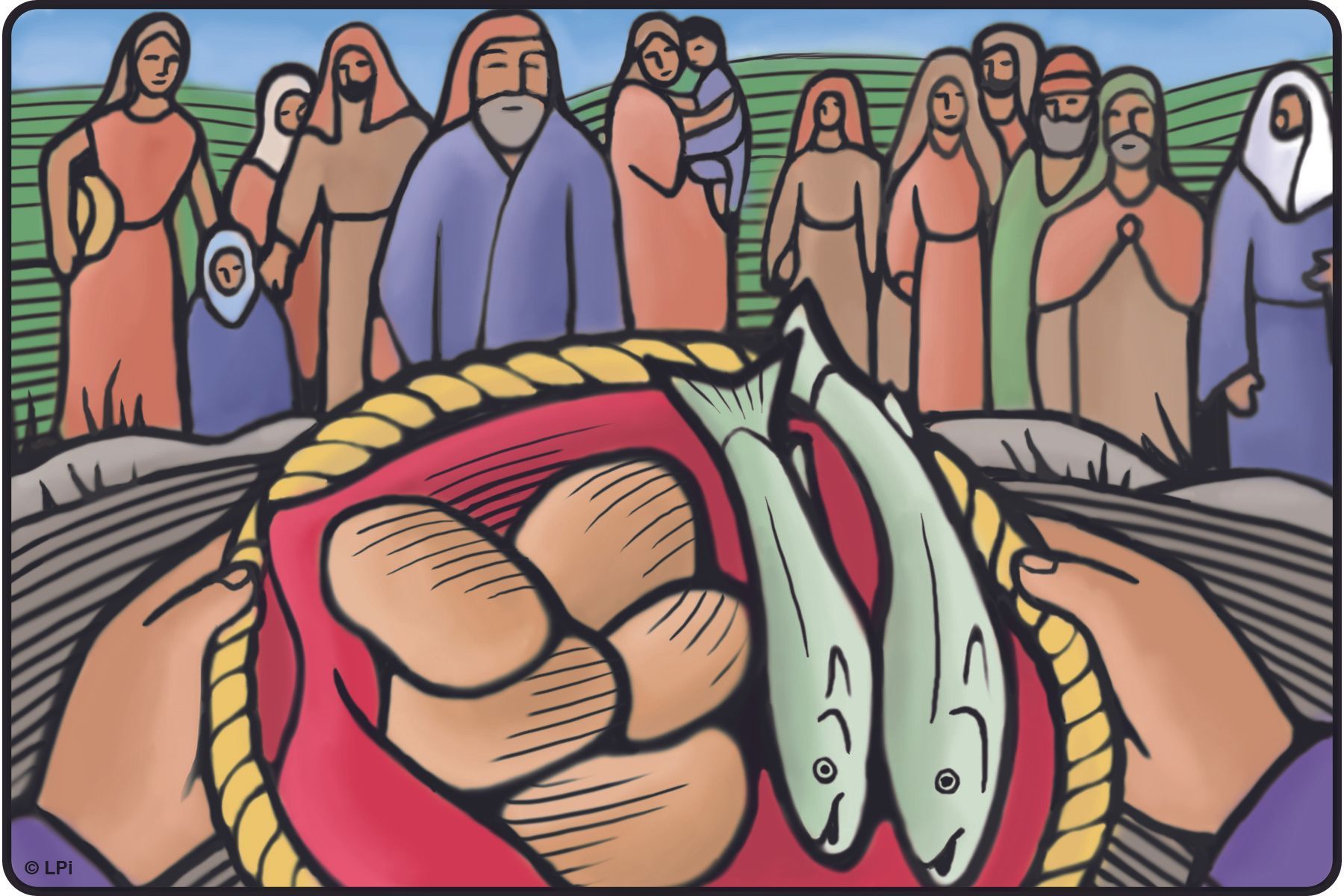
The gospel begins with the words: When Jesus heard of the death of John the Baptist.... John is Jesus’ cousin; John is the one who leaped in his mother's womb when he met Jesus in his mother’s womb. John is the one who baptized Jesus and now Jesus hears that John is dead by being beheaded. Jesus is in grief and wants to be alone. We are told that in his grief, Jesus went off to be alone. Word gets out where Jesus is and all the people show up looking for him to heal and feed them. We are told that Jesus’ heart is full of compassion for the people. Rather than telling them to go away, to let him be, he heals them. This is the life of a disciple – people are not in need on my schedule. When people show up, I need to attend to them. We can never do ministry with our eye on the clock. Although he was tired and in grief, Jesus cared for the people. He knew he could not be there always and his disciples would need to help out. When the disciples tell Jesus the people are hungry, the disciples were the hungry ones. Jesus tells them to give them something yourselves. This is Jesus’ way of calling them to act as disciples. I have fed them with my words; if they need food for their bodies, give it to them yourselves. The disciples find five loaves and two fish. Jesus offers a prayer. Jesus gives thanks for what has been provided, an action of gratitude. He then gives them to the disciples to distribute. Jesus is asking them to continue his ministry by feeding the people. What is left over fills 12 baskets; the number 12 reminds us of the 12 tribes. Jesus has come to feed the whole world. Jesus provides the feast and we as disciples share what we have been given with others. The five loaves and two fish are enough to feed the crowd and provide many leftovers. Our God is a God of abundance. What God has provided is not wasted and what God has provided is given to us by disciples who participate in God’s work. If we are to be disciples, we need to learn how to feed others. Like Jesus, we may find that being a disciple interrupts our life. When someone is in need we attend, we put aside our own agenda for a time and attend to the person in need. Our grief may come later after we care for the person in need. Those who were fed echo the words of Isaiah in the first reading. They come and are fed body and soul. The feeding of the soul are the words of Jesus and the feeding of the body comes from the hands of the disciples.
