Fourth Sunday of Advent, Year A

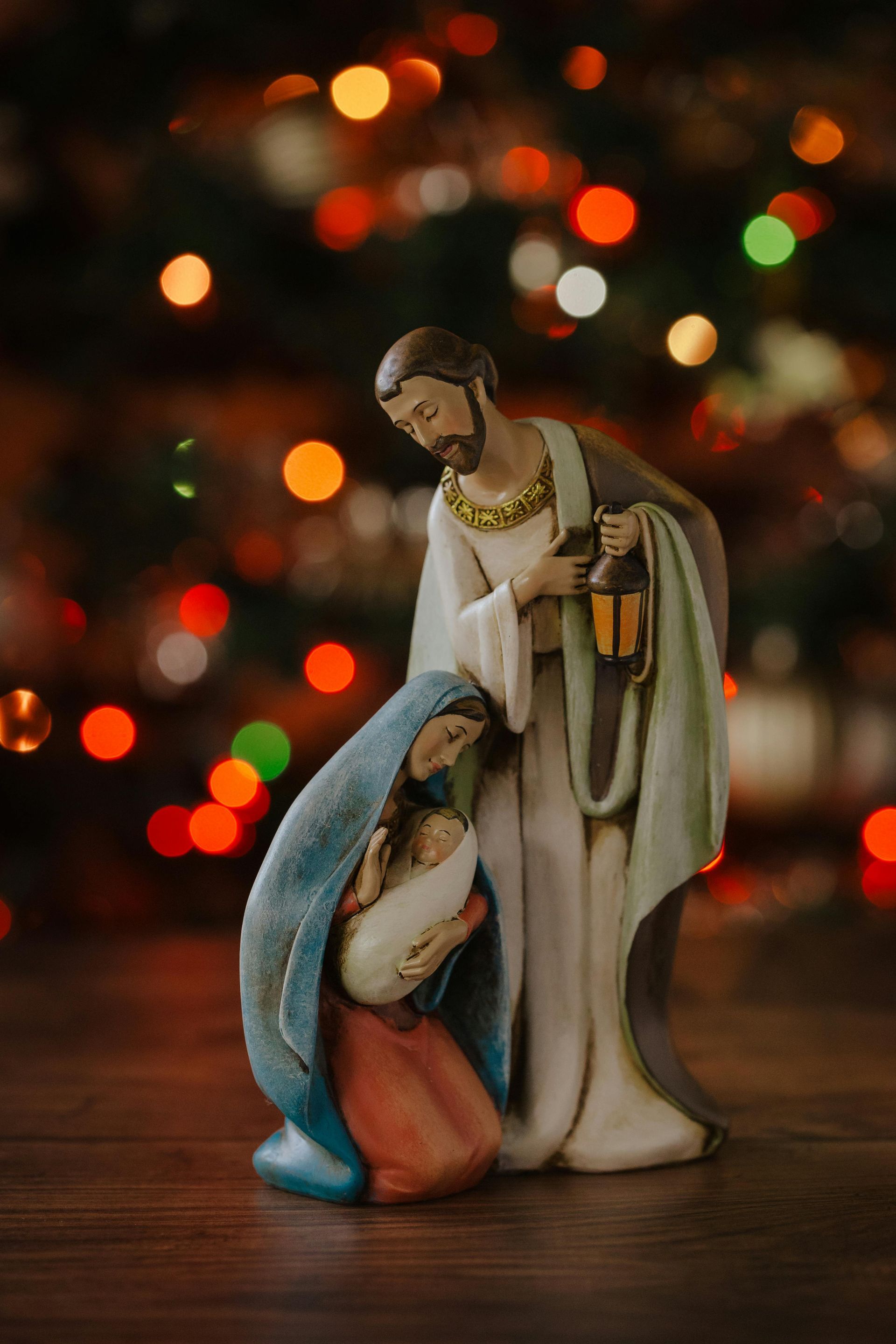
Two weeks ago, on the Solemnity of the Immaculate Conception, we heard the Gospel account of Mary receiving the news of her pregnancy from the Angel Gabriel.  Today’s Gospel passage tells us the story of Joseph receiving the same news.  It's not a stretch to imagine, knowing this is not his child, that he might have been filled with a range of emotions as this news settles in, with these emotions giving way to a pervasive feeling that his world — and Mary's — have been irreparably changed. 


Perhaps, maybe more than likely, he wrestled with this news as a weight-settled-in the-pit-of-his-stomach nameless opponent in fitful sleep until, in a dream, the Angel of the Lord appeared and named that opponent, saying, “Joseph, son of David, do not be afraid.”  Fear — Joseph is wrestling with fear.  Fear for himself.  Fear for Mary.  Fear of a changed and unknown future.  Joseph's fear, and the comforting by the angel of the Lord, mirror Mary’s same fear and comforting by the Angel Gabriel when she received the same news. 


I don’t think it's a coincidence that the Church gives us bookend accounts of the Annunciation and this parallel comforting message from God to not be afraid twice in Advent, here in these days of waning light and nights of growing darkness.  Fear is part of the human condition, and God’s continual assurance to not be afraid is a testament to God’s desire for us — to be free from the shackles of fear.  The most common phrase throughout Scripture is, “Be not afraid.”


When I was in formation to become a deacon, I was assigned to assist as a hospital chaplain at Albany Med for a few overnights with a deacon serving as the regular overnight chaplain.  One of these nights came after a blistering hot day in August.  As we began our shift that evening, we gathered in the pastoral care office at Albany Med to obtain the list of patients to visit, some requesting Communion and some simply requesting a visit from the chaplain.  There was the name of a woman to visit; nothing noted other than a room number. 


As we approached the room where we were to find this woman, the deacon I was with remarked to me offhand, “This must be a pregnancy complication.  The normal pregnancies are all on lower floors.”  As we entered the dimly-lit room, I immediately sensed a pervasive weight in the room: things were not alright.  Accentuating the atmosphere was the spectacular electrical storm raging outside that night, lightning filling the panoramic window of the maternity room. 


We were introduced to the woman on our list: a young mother, her husband, their new baby girl, their first child.  Here in this room in Albany Med was a Holy Family.  The new mother shared that she had complications in the pregnancy and that she had developed a massive blood clot and was going into surgery the following morning.  The lightning bolts arcing across the sky were like the huge red dragon described in the Book of Revelation awaiting the woman to give birth to the child; each bolt was its tail, sweeping away the stars of the night sky.  It seemed the dragon was raging at this Holy Family, and as evident on their faces, raging within this Holy Family.  And the dragon’s name was Fear.   


When we told them that we had brought Communion and asked if they wanted to receive, they were grateful and responded they very much wanted to receive.  It was clear at that moment that the Presence of Christ in the Eucharist was a gift of great consolation to them, as their fears gave way to tears of relief and release.  They were not alone; Jesus, Emmanuel — God is with us — was with them in the midst of the storm in their life that night and calmed their sea of fear.  God was with them, just like he was with Joseph and Mary those nights some two thousand-plus years ago when the Angels of the Lord said to both of them, “Do not be afraid.”  God is with us.


What are the dragon-storms of our lives threatening to devour us?  Do we, like Joseph and Mary, need to hear God’s message, “Do not be afraid”?  Do we need to quiet the din of our lives in order to hear God’s message?  Do we need to reconnect with the peaceful presence of God in our midst, accepting God’s message, and like Mary and Joseph, entrusting our fears to God, allowing Him to displace fear in the midst of our storms?  Fear does not have the last word; Jesus Christ does, he who dispels the darkness.  Emmanuel — God is with us.  God is with us now, and God is faithfully with us forever.   

By Rev. Christopher Welch July 5, 2026
On this July 4th weekend, we recall our land’s independence from a foreign king and a foreign government. We have thrown off the yoke of King George III; we are a free and independent nation. For 250 years we have been learning what it means to live as an independent and free society. Today Jesus invites us to consider taking upon a yoke as we go forward as disciples of him. The yoke of King George was too heavy for this nation, but the yoke of our God, we are told by Jesus, “is easy and light.” What is the yoke of Jesus? The yoke of Jesus is about the kingdom of God, learning to love others as we love ourselves. As disciples of Jesus we take on the yoke of the Gospel. When life feels heavy, we turn to our God, and our God helps to make our burdens light. There are many things in life that may seem like a yoke, a burden, but if we look at them in a new way, we see our God helping us to carry our burden. As Jesus invites us to consider the childlike, let me share with you a story: The Fable of The Birds At the beginning of time, all the animals were walking around discovering what it was like to be alive. All except the birds! They were doing nothing but complaining because God had given them a heavy burden that he’d given to no other animals: those awkward appendages on their shoulders. God must be punishing them somehow. Why did they have to carry these things around, making it hard to walk? “Why?" they asked. “Why us?” Finally, two or three of the more adventurous birds began to move their appendages. They began to flutter them, and soon they discovered that the very things they regarded as a burden actually made it possible for them to fly. And no other animals could fly. The “heavy burden” turned out to be a wonderful gift. Is there something in your life that at first glance seemed a burden, but later was seen as a gift? One reason why we value the innocent and simple among us is that they can help us to see life and who we are with new eyes. The simple or innocent can sometimes help us see what we thought was a burden as a gift. In the lives of the saints, we read about many who took what seemed to be a burden and made it an asset: The first disciples were simple fishermen. They were not scholarly, they couldn’t read, but they took their experience of Jesus and let it form them as disciples. What was a burden became an asset. Peter denied the Lord on the eve of his death. This made him more compassionate to sinners and those who struggled to have courage. Paul was blinded for 3 days; a former killer of Christians saw with new eyes and preached the good news to the Gentiles. Thomas doubted the Resurrection but came to faith in his doubt. Theresa the Little Flower loved Jesus and others with the simple love of a child of God. St. Kateri looked for and saw God present in the trees and the nature of the forests where she made her home. Mother Teresa of Calcutta saw our Lord present in the sick and dying in India. Blessed Stan Rother, a farmer’s son from Oklahoma who couldn’t read Latin, learned to speak in the native tongue of the men and women who he ministered with in Guatemala. With the eyes of a child, with childlike faith, we learn to see the burdens we carry as paths to faith in the help and care of our God. Let us give thanks today for the gift of freedom and let us give thanks for the gift of our God who makes our burdens light.
By Rev. Christopher Welch June 28, 2026
Our readings today speak of hospitality: In the first reading from 2 Kings, we hear how the woman made a room for the prophet Elisha. In the letter to the Hebrews, we read, “Be not forgetful to entertain strangers, for thereby some have entertained angels unawares.” In the Gospel, Jesus speaks, “and whoever receives me receives the one who sent me.” Hospitality is the essence of the life as a Christian. Many religious communities include this action as part of their rule. Hospitality is not easy. It seems that people are not in need on my schedule. Hospitality means stopping my actions and attending to others for a time. People are not in need on my schedule. Yet if I neglect them, I may miss out on entertaining angels. This summer there will be many who are in need. To them we offer our time and our hospitality. We are fortunate in our community that a hot meal is available seven days a week. I meet many in need when I stop to help out at Saturday’s Bread. Catholic Charities provides lunches to our students in July and August. You may want to consider helping to provide meals to our homeless and our students in the summer. It is so easy to get caught up in my schedule and I miss the chance to meet Christ in my neighbors and to miss out on entertaining angels. One thing I admired about Bishop Hubbard is that when he spoke to you, you were made to feel you were the most important person. As he spoke to you, he was moving on down the line, but for that moment you felt important, you were the most important person at that moment. How often do we make others feel that they are taking up our time or are a burden? On Thursday we celebrated LEON Day (Noel spelled backwards), which reminds us that we are six months away from Christmas. Maybe this is a good time to revisit a Christmas story. La Befana: The Witch of Christmas By Il Postino Staff and Tessa Derksen The legend of Befana began thousands of years ago and remains to this day a tradition practiced by Italian children and their families. As the story goes, one day, the three Magi left their country bearing special gifts of gold, incense and myrrh for the new-born Jesus Christ. They were guided by a star across many countries. At every village that they passed, people ran to meet them and accompany them in their journey. But there was one old woman who did not join the Magi. She claimed to be too busy with her housework and promised to join them later when she had time. The next day, she realized her mistake and frantically ran after the Magi with gifts for the child, still clutching her broom. But it was too late – the Magi were long gone. Let us not be too busy to meet Christ in our neighbors. Let us not be a Befana.
By Rev. Christopher Welch June 21, 2026
The last two popes chose names that pointed out what their main concern in their ministry would be. Pope Francis took the name of a man who advocated for the poor among us. Pope Leo XIV took the name of the pope who advocated for dignity of the workers in the world. Pope Leo XIII wrote the first encyclical speaking of the dignity of workers. His encyclical Rerum Novarum spoke of how the church should be an instrument for change in the world. Pope Leo XIV, in his encyclical Magnifica Humanitas , addresses his concern for the use of AI in our world. AI used in the correct way can be of benefit to humanity. Used in the wrong way, AI can lead to taking away the humanity of people. He uses two images to speak of AI. AI used in the wrong way can be like the Tower of Babel. The Tower of Babel, as found in the book of Genesis, was a tower built by people who sought glory for themselves. They had a single technology, a single goal all directed toward themselves without a concern for God. They started out united and the project caused division. Here is how Pope Leo puts it in his encyclical: The result is not unity, but dispersion. Babel thus reveals the limits of any effort that, however grandiose, arises from self-affirmation, sacrifices human dignity for efficiency and aspires to reach heaven without God’s blessing. The second image is taken from the book of Nehemiah, where the walls of Jerusalem were rebuilt. This is the image for the correct use of AI -- a technology that unites people, with God at the center, and preserves the dignity of the human person. Again, Pope Leo: It is an undertaking with God at the center, which rebuilds relationships before rebuilding with stones. Thus, ancient Jerusalem rediscovers a common language -- not one of uniformity, but one of communion, namely the harmony that arises when all persons assume their own role and recognize that their strength comes from the Lord. The pope expresses concern that AI may be used in ways that deny the unique nature of humans. As we go forward, we need to decide what we will build: will we build a Tower of Babel or the city of Jerusalem? The Pope ends his reflections by giving Mary’s song, the Magnificat , as the example on how we go forward: With the same faith as Mary, let us become “weavers of hope” in our world, sharing who we are and what we have, so that the presence of Jesus may grow among us and his Kingdom take shape. In the humble fidelity of daily life, even the era of AI can become a time in which the Holy Spirit brings about the civilization of love in our lives. Indeed, the Lord continues to make all things new and offers every era the possibility of becoming part of salvation history in the light of the Incarnation. I entrust our desire to the Mother of Christ, to the Woman of the Magnificat, that she may guide our steps through this time of change and preserve in each of us true faith in the Gospel, so that we may bear witness to the grandeur of humanity, in which God has made his dwelling.