By Deacon Paul Cerosaletti
•
March 22, 2026
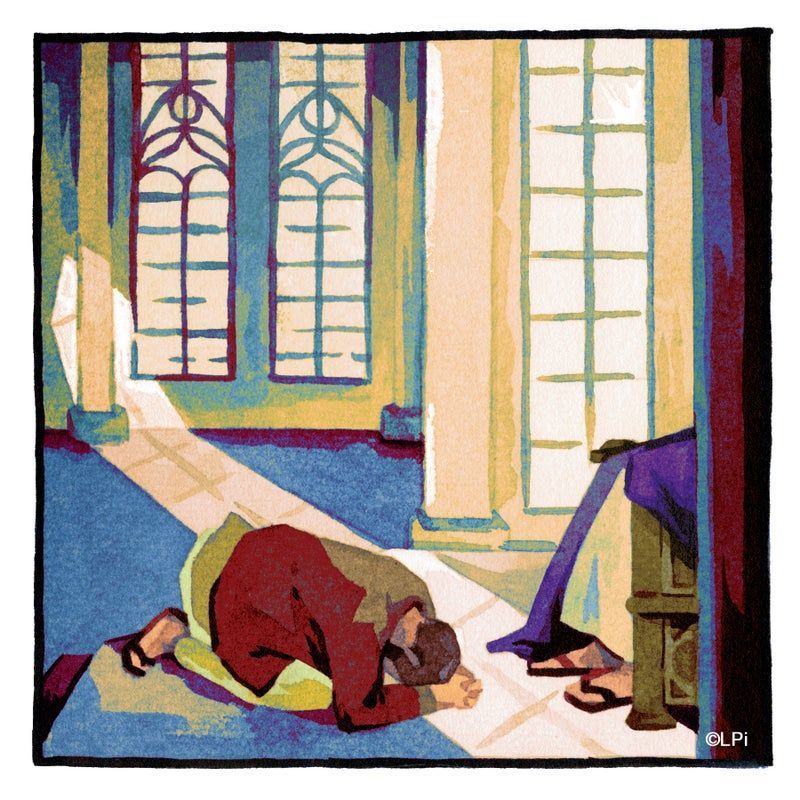
And Jesus wept. These three words are a pivot point in the Gospel passage we hear today. A pivot point between Jesus prophesying about the resuscitation of Lazarus, prophesying about the promise of eternal life for His believers, and testifying to His Divine nature as the Resurrection and the Life. A pivot point between Christ’s prophecy and testimony and Christ acting in His Divine nature as God the Son, calling Lazarus out of the sleep of death, out of the tomb, resuscitating him to life. And in that pivot point, in those three words — “And Jesus wept” — is the fullness of the humanity of Christ. For we profess a God and Savior, Jesus Christ, who is fully Divine and fully human. And what could be more human than to weep? Biblical scholars note that the word “wept,” translated from the original Greek term, in this Gospel means literally that he burst into tears; he is sobbing. It is not the same Greek term used to describe the weeping of Mary and Martha, which is translated as crying and wailing aloud. Jesus’ is a more quiet grief expressed by a profuse flowing of tears. In His incarnation Jesus took on flesh to become one of us, fully human — and there may be no more profound expression of Jesus’ humanity than his sobbing at the tomb of Lazarus. Psalm 116 tells us that “Dear in the eyes of the Lord is the death of his devoted one” (Ps 116:15). What more dear, more sincere way could God express his love for us than to weep for His beloved, to weep for us? There was a very popular 1970s television war comedy-drama called M*A*S*H . Most of us here today know and remember that television series well; some of us grew up with it. For those of you who have never heard of M*A*S*H , it was a series set in the 4077th M obile A rmy S urgical H ospital — hence M*A*S*H — operating in the early 1950s in Korea during the Korean War. It was humorous, punctuated with the quick verbal wit of Drs. Hawkeye Pierce, Trapper John McIntyre, and BJ Hunnicutt — and, at the same time, it was also poignant, laying bare the suffering of humanity — physically, emotionally, and spiritually — amidst the tragedy of war. In one episode, the 4077th receives a wounded soldier with a superficial head wound who has no dog tags. When asked what his identity is, the soldier responds that he is Jesus Christ, and continues to insist so in a calm manner to all who approach and ask him in the hospital ward. The staff learn through Army intelligence that this man was a highly decorated bombardier named Captain Arnold Chandler, a farm boy from Idaho who had flown over 50 bombing missions in North Korea before his B-29 bomber was shot down. Believing this man might be deeply wounded psychologically, the 4077th doctors bring in the Army psychiatrist Major Sidney Freedman to evaluate him. In the poignant exchange between Dr. Freedman and the man, Sidney asks the man how long he has known his true identity, that of Arnold Chandler, and then goes on to give him a short synopsis of his life and military career. The man responds to a series of questions, stating that he is not Captain Chandler, that he is not from Idaho, and that he is not a bombardier and gently insists, “I am Christ the Lord.” Sidney, going along with the new identity, counters by saying, “But you died,” to which the man responds, “I rose”. Sidney replies, “That was a long time ago. Where have you been since then?” The man responds, “I live on in all [mankind].” Sidney then asks, “What are you doing here in an army hospital?” The man responds, “I’m Christ. Where should I be?” Countering the man’s question, Sidney asks further, “Should you be in the nose of a B-29, dropping bombs?” The man responds, “Bombs. On people?” At this, the expression on the man’s face becomes troubled. Sidney replies, “On the enemy,” to which the man responds, “I have no enemies. I love all men.” Sidney counters, asking “Even the North Koreans?” The man looks up, away from Sidney, tears welling in his eyes; now deeply troubled, he says, “They’re my children. Why would I hurt my children?” A tear runs down his cheek. And Jesus wept. Do you suppose Jesus Christ, our Resurrected and Ascended, fully Divine and still fully Human Lord, weeps today? Does He weep for his children who fight and destroy, who suffer, hurting and killing each other today? I suppose He does. Jesus is wounded and suffers in and through his Body, that is, all of us, through whom he lives on. All of us, made in the image and likeness of God. We, who are God’s handiwork. We, who are God’s creation. O Jesus, may your grief and weeping give us to know that the actions of humanity hurt you. May the well-spring of your tears be the living waters that extinguish our thirst for anger, animosity, revenge, and violence. May they be the waters that wash away our blindness, healing us, reviving us to life again. May the tears that well up from your eyes wash over us like the waters that flowed from your side upon the Cross. And may your tears fall upon us like the rains of the Great Flood, flow over us like the waters of baptism, and make an end of our vice and a new beginning of our virtue. And Jesus weeps.