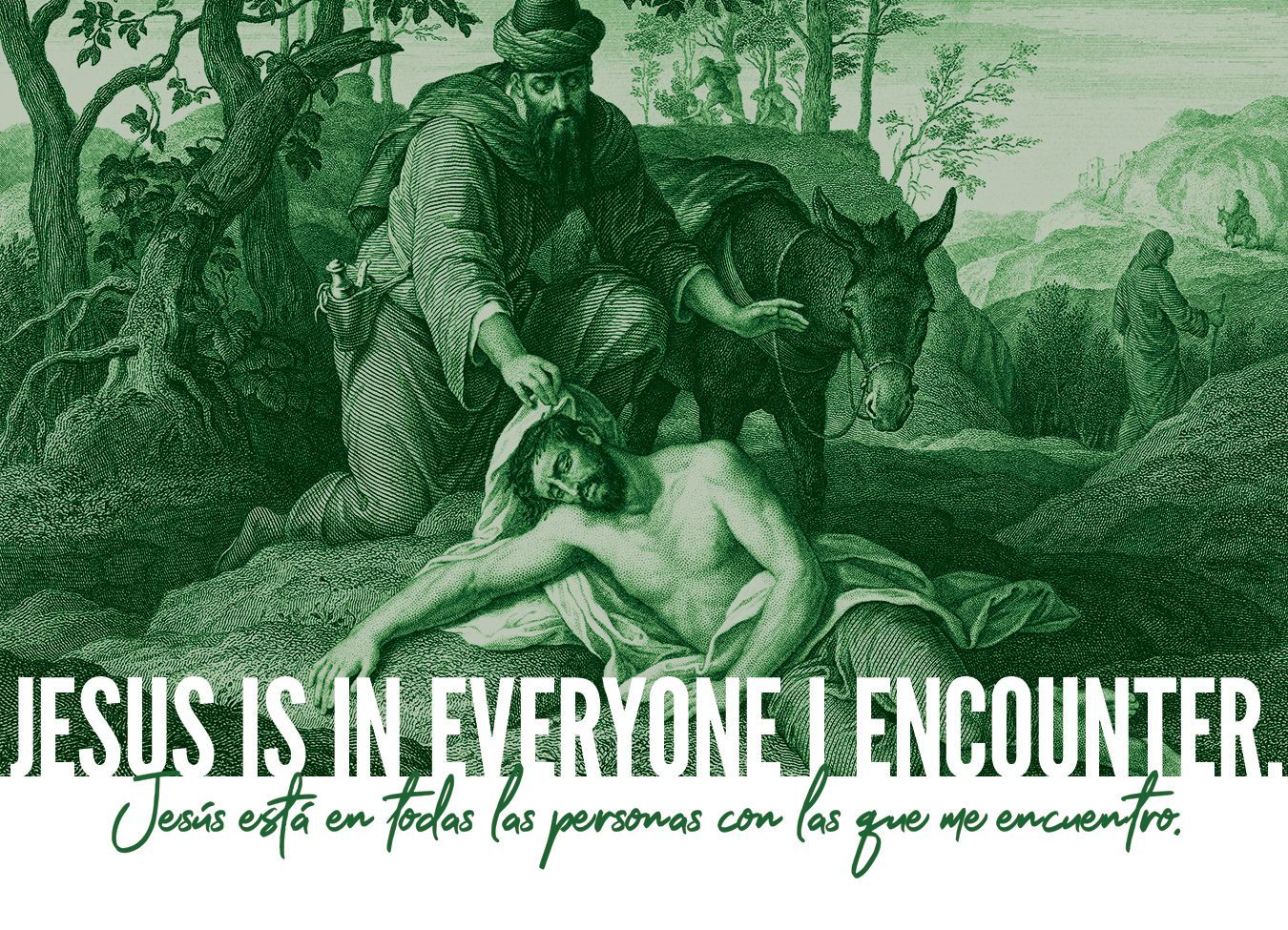
16th Sunday in Ordinary Time, Year C

Last week we heard the parable of the Good Samaritan, which Jesus gives us in response to the question, “And who is my neighbor?”  Today we hear two readings — the first reading from the Book of Genesis, and the Gospel passage from Luke — that invite us to engage with another question:  Who is this stranger in my midst?   


In the first reading, three strangers appear in Abraham’s and Sarah’s midst.  We are told in the beginning of the passage that it is the Lord who appears to them, but they do not yet know it is the Lord.  Yet how do Abraham and Sarah respond?  With an outpouring of hospitality — serving the strangers in their midst with gladness.  In the Gospel passage, we hear that Jesus enters a village where Martha welcomes him and calls him Lord.  But does she really yet know who Jesus is?  It’s questionable, as she goes on to triangulate Jesus into a conflict with her sister and attempts to lay a guilt trip on him, saying, “Don’t you care that my sister has left me by myself to do all the serving?” and then proceeds to tell Jesus — God — what to do: “Tell her to help me.”  Her words and actions suggest she does not realize who she is in the presence of.  Even if she professes him as Lord, does she really believe it yet?  Yet her sister Mary seems to.  Even if Mary doesn’t really yet know who Jesus is, who is in her midst, she treats him with a focus and attentiveness that in itself recognizes the presence of God in the person in her midst. 


In the countries of India and Nepal there is a principle of hospitality that “the guest is God”, which is based on stories that mirror the story of Abraham and Sarah, where the guest is revealed to be God who rewards the provider of the hospitality.  Abraham and Sarah receive a son…


The word hospitality derives from the Latin word hospes, which means stranger, foreigner, or guest.  It came to signify the relationship between the guest and the provider of hospitality.  Hospes is also the root word for hospital — another tie to last week's Gospel passage on the Good Samaritan, for what did the Good Samaritan provide to the robber’s victim but none other than hospital.  Today, we view the words ‘hospitality’ and ‘hospital’ in different contexts, yet each is about providing care for the guest, the stranger.  And through that care, that relationship, restoration and healing.   


These scripture and Gospel passages reveal to us a deeper and profound truth in which we are invited to engage:  that in the others we encounter, whether a suffering brother or sister on the side of life’s road, or a visitor come into our midst — whether they are known to us, or they are strangers to us (especially if they are strangers to us) — we are to recognize God in them and see in them the Face of Christ.  And we are invited to attend to them, in the manner the Good Samaritan did; in the manner that Abraham and Sarah did; in the manner Mary did.  Giving them our presence and attention, willingly and joyfully pouring out upon them acts of service, caring and entering into a relationship that restores and heals them.   


St. John Paul II wrote, "Welcoming our brothers and sisters with care and willingness must not be limited to extraordinary occasions but must become for all believers a habit of service in their daily lives,” (1) hospitality that must “never [be] formal or superficial but identified by 'gentleness' and 'reverence'” (2).


Today, when we exchange the sign of peace, or after Mass, reach out and welcome the stranger in our midst.  Let us keep doing the same when we leave the church building, reaching out with our presence and attention, gentleness and reverence that honors God in the ‘other’ in our midst. 


 1. "Address of His Holiness Pope John Paul II to volunteer workers". The Holy See. Libreria Editrice Vaticana. 8 March 1997.

 2. "Pastoral visit to the island of Ischia. Homily of John Paul II". The Holy See. Libreria Editrice Vaticana. 5 May 2002.
By Fr. Christopher Welch February 15, 2026
The last line of our gospel speaks of saying yes and saying no:  Let your ‘Yes’ mean ‘Yes’ and your ‘No’ mean ‘No’. (Matthew 5:37) When we say ‘yes’ to one thing, we may be saying ‘no’ to another. Sometimes our choices are among goods. We may need to prayerfully consider what to say ‘yes’ to. The words of Jesus imply that once we have made a choice, we need to stick with it. Too often we say ‘yes’ and later regret what we said ‘yes’ to. It may take time to grow into the choice we have made. We may need to stick with it for a time, and in time, our choice may feel right. When I took on my first assignment as a pastor, Bishop Hubbard advised me, “Make no large decisions the first year.” I found this to be sage advice. I found it takes time to get to know others and to find my way. Those who are in recovery are advised not to enter into any new relationships in their first year of recovery. This is also sage advice; the first year is about focusing on a new life of recovery, it is not the time to begin a new relationship. In time things make sense. I recall the words of Tevye and Golde in Fiddler on the Roof : (Tevye) "Golde I'm asking you a question..." Do you love me? (Golde) You're a fool (Tevye) "I know..." But do you love me? (Golde) Do I love you? For twenty-five years I've washed your clothes Cooked your meals, cleaned your house Given you children, milked the cow After twenty-five years, why talk about love right now? (Tevye) Golde, The first time I met you Was on our wedding day I was scared (Golde) I was shy (Tevye) I was nervous (Golde) So was I (Tevye) But my father and my mother Said we'd learn to love each other And now I'm asking, Golde Do you love me? (Golde) I'm your wife (Tevye) "I know..." But do you love me? (Golde) Do I love him? For twenty-five years I've lived with him Fought him, starved with him Twenty-five years my bed is his If that's not love, what is? (Tevye) Then you love me? (Golde) I suppose I do (Tevye) And I suppose I love you too (Both) It doesn't change a thing But even so After twenty-five years It's nice to know. The most important ‘yes’ we make is a ‘yes’ to the Lord. It may take time to figure out what this may entail. This was true for Mary when she said ‘yes’ to the angel. Jospeh also had to say ‘yes’. Neither knew where that ‘yes’ would take them, and so it is for us. I am reminded of the words of Michel Quoist in his book Prayers of Life : Help Me to Say ‘Yes’ I am afraid of saying ‘Yes,’ Lord. Where will you take me? I am afraid of drawing the longer straw, I am afraid of signing my name to an unread agreement, I am afraid of the ‘yes’ that entails other ‘yeses.’ And yet I am not at peace. You pursue me, Lord, you besiege me. I seek out the din for fear of hearing you, but in a moment of silence you slip through. I turn from the road, for I have caught sight of you, but at the end of the path you are there awaiting me. Where shall I hide? I meet you everywhere. Is it then impossible to escape you? But I am afraid to say ‘Yes,’ Lord. I am afraid of putting my hand in yours, for you hold on to it. I am afraid of meeting your eyes, for you can win me. I am afraid of your demands, for you are a jealous God. I am hemmed in, yet I hide. I am captured, yet I struggle, and I fight knowing that I am defeated. For you are the stronger, Lord, you own the world and you take it from me. When I stretch out my hand to catch hold of people and things, they vanish before my eyes. It's no fun, Lord, I can't keep anything for myself. The flower I pick fades in my hands. My laugh freezes on my lips. The waltz I dance leaves me restless and uneasy. Everything seems empty, Everything seems hollow, You have made a desert around me. I am hungry and thirsty, And the whole world cannot satisfy me. And yet I loved you, Lord; what have I done to you? I worked for you; I gave myself for you. O great and terrible God, What more do you want? * * * Son, I want more for you and for the world. Until now you have planned your actions, but I have no need of them. You have asked for my approval, you have asked for my support, you have wanted to interest me in your work. But don't you see, son, that you were reversing the roles? I have watched you, I have seen your good will, And I want more than you, now. You will no longer do your own works, but the will of your Father in heaven. Say ‘Yes,’ son. I need your ‘yes’ as I needed Mary's ‘yes’ to come to earth, For it is I who must do your work, It is I who must live in your family, It is I who must be in your neighborhood, and not you. For it is my look that penetrates, and not yours, My words that carry weight, and not yours, My life that transforms, and not yours. Give all to me, abandon all to me. I need your ‘yes’ to be united with you and to come down to earth, I need your ‘yes’ to continue saving the world! * * * O Lord, I am afraid of your demands, but who can resist you? That your Kingdom may come and not mine, That your will may be done and not mine, Help me to say ‘Yes.’
By Fr. Christopher Welch February 8, 2026
Deacon Greg Kandra tells the story of meeting a person who chose to convert to the Catholic faith. He asked why this person chose to convert and was told, "because of my boss.” Deacon Kandra asked why and was told, “He seemed to glow with the light of God and I decided I wanted what he had.” I am reminded of the words of Ralph Waldo Emerson, “What you do speaks so loudly I cannot hear what you are saying.” It is not the words that attract people to the Lord; often it is how we live our lives that makes the difference. Jesus reminds us not to hide our light under a basket. The prophet Isaiah gives us a list of how we shine our light in the world: Share your bread with the hungry, shelter the oppressed and the homeless; clothe the naked when you see them, and do not turn your back on your own. Then your light shall break forth like the dawn... (Isaiah 58:7-8) Many will stand on soap boxes and proclaim how good they are. It is not their words that speak to us but their actions. This is what Emerson is speaking about and what that person’s boss proclaimed. They did not hide their lamp but let their good works speak for them. St. Mother Teresa of Calcutta spoke about this in her poem Anyway : People are often unreasonable, illogical and self-centered; Forgive them anyway. If you are kind, people may accuse you of selfish, ulterior motives; Be kind anyway. If you are successful, you will win some false friends and some true enemies; Succeed anyway. If you are honest and frank, people may cheat you; Be honest and frank anyway. What you spend years building, someone could destroy overnight; Build anyway. If you find serenity and happiness, they may be jealous; Be happy anyway. The good you do today, people will often forget tomorrow; Do good anyway. Give the world the best you have, and it may never be enough; Give the world the best you've got anyway. You see, in the final analysis, it is between you and your God; It was never between you and them anyway.  (Inscribed on the wall of Mother Teresa's children's home in Calcutta) In these cold dark days, we are invited to share the warmth and light of the spirit of our God with those who we meet.
By Fr. Christopher Welch February 1, 2026
THE SEARCH by Shel Silverstein I went to find a pot of gold That's waiting where the rainbow ends. I searched and searched and searched and searched And searched and searched, and then— There it was, deep in the grass, Under an old and twisty bough. It's mine, it's mine, it's mine at last.... What do I search for now? So often we look at life as a destination. How often as children did we bug the driver of the car with the endless question, “Are we there yet?” The spiritual masters remind us that life is not about the destination, but the journey. How much we would miss if we didn’t take the journey. The Prophet Zephaniah encourages us to “seek the Lord”. One way we seek the Lord is by our poverty of spirit. We are blessed as we begin to recognize that I am not in charge, God is the one in charge. I let God set the agenda. One aspect of wisdom is knowing I am not wise. St. Paul, in his letter to the community at Corinth, speaks about true wisdom: God chose the foolish of the world to shame the wise, and God chose the weak of the world to shame the strong. Sometimes it is the foolish who get it: the foolish see that the journey is the goal, not the pot of gold under the rainbow. The challenge is learning to live day by day and let God be the one in charge. Sometimes God acts to remind us of who is in charge. The storm this week reminded us that we are not in charge. Our plans needed to be changed to address the issues of the storm. We had a choice; we could have cursed the storm or adjusted our expectations. We are on a new journey. The pot of God may have hidden in the people and projects we addressed this week. In a few short weeks we will begin the season of Lent, a journey we take toward the most important days of the year. Holy Week lays out for us the mysteries of our faith: the Passion, Death, and Resurrection of our Lord. How will we take this journey? How will we seek the Lord? Lent is a search, not for pots of gold, but for a deeper relationship with the Lord. I went to find a pot of gold That's waiting where the rainbow ends. I searched and searched and searched and searched And searched and searched, and then— There it was, deep in the grass, Under an old and twisty bough. It's mine, it's mine, it's mine at last.... What do I search for now?