
Second Sunday of Easter (Divine Mercy), Year A
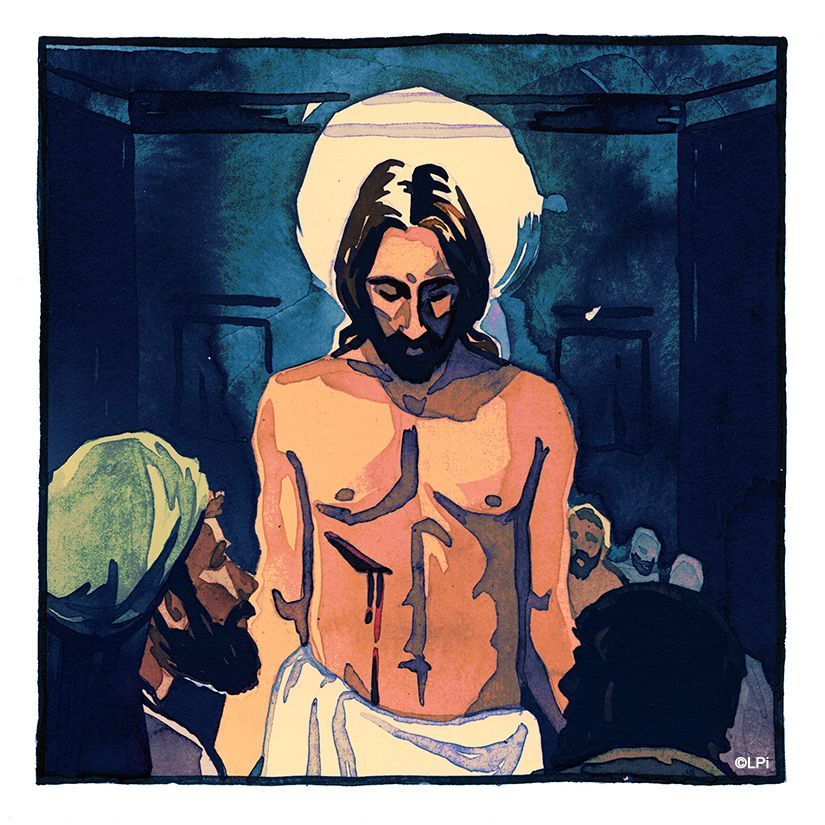
It is said that when Oliver Cromwell had his official portrait painted, he asked that it be a true portrait with “warts and all”.


You may say that the resurrected Christ appeared with “wounds and all”. Here is the resurrected Christ in his glorified body, who could pass through locked doors, appearing with the wounds of his crucifixion. He is resurrected, not simply resuscitated, in his glorified body still bearing the marks of his passion and death.


Why, if he is in his perfect resurrected body, does Jesus still bear the marks of his passion and death?


It is an interesting paradox that the woundedness of our lives can be what makes us who we are. There is a story told about a man in therapy:


When he first met the counselor, he was asked to draw a picture of himself; he drew a picture of a vase with a crack in its side.  After many years of therapy, the counselor showed the man the picture he had drawn.  The man asked for use of the crayons.  He took a yellow crayon and drew yellow strips just above the crack in the vase.  When asked why he did that he told the counselor, “The crack is where the light can get in.”


Leonard Cohen summed it up well in his song “Anthem”:


There is a crack, a crack in everything.

That’s how the light gets in. 


By showing the apostles his wounds, Jesus is reminding them that the wounds, the pain is not the end of the story.  Many of us bear wounds from our past; they are what make us who we are.  Part of the journey is the struggle.  When we reach our destination, we can look back and see how the struggles made us who we are.


Elbert Hubbard, the founder of the Roycrofters, once said, “God will not look you over for medals but for scars.”


I am sure the disciples looked over the past three years and saw how the struggles made a difference; their time with Jesus made them new people.
 

By Deacon Paul Cerosaletti April 4, 2026
Growing up on the family dairy farm, there were many difficult things we experienced. Certainly, there was much hard, physical labor. But among the hardest things we experienced was caring for sick animals, and in particular, caring for cows that had been injured or lost muscle strength and were unable to get themselves up to a standing position. This typically would happen around the time of calving and might be due to a nerve injury during birth or mineral and metabolic imbalances that affected muscle strength. We called them “down cows”. What was so hard about dealing with down cows was really two things: one, the size of the animals — often 1000 lbs. or more — made it difficult, if not impossible, for us to help them physically if they had little or no muscle strength of their own. Secondly, and more profound, was the emotional burden that weighed upon us as their caregivers. We wanted them to get better and be back on their feet. We loved our animals, as all farmers do, and we wanted the best for them. Although we could help them with support therapies and medicine with help from our veterinarian and made sure they had feed and water at all times, it felt like there was only so much in our control. And the longer a cow was down, the less likely it would be that she would ever rise again. Some never did. That outcome happened frequently enough that it was a real possibility. And there is nothing that was more discouraging for us as farmers than a cow we could not help to get better. It cast a pall over our days and robbed us of hope and joy — really, robbing us of life — replacing them instead with weary discouragement. Late one Lent going into Holy Week, we had one of these down cows. It was a year not unlike this one, with the signs of spring beginning to emerge in early April. My father used to say the best thing we could do for a down cow was to get her out of the barn and out onto the earth in the fields or pasture, where there was no concrete and better footing. So we did, and we were able to get this cow out of the barn and into the hayfield behind the barn. There, day after day, we would take her food and water, administer medicine to her, and roll her over from side to side, to make sure she did not lose circulation in one hindquarter or another. If she seemed like she wanted to get up, we would try to get enough people to see if we could help her get up. Although she ate and drank, she did not get up, and as Holy Week wore on, it felt like she wasn’t going to. That discouragement set in as a constant droning undertone to everything we did throughout the day, seemingly getting louder with each passing day. Whether we were thinking about that down cow consciously or not, it seemed to affect our outlook and demeanor in everything we did. Late one night that week, my father, brother and I were finishing evening milking. It was after dark; we were at the far end of the barn, near the door going out to the hayfield. As I came out from between two cows holding the milking machine, I turned towards the open barn door and was shocked when I found myself face to face with the previously down cow, standing there, head poked in the barn door, chewing her cud! I shouted to my father, “Dad, she’s up!” We all ran over to the barn door, peering into the darkness of that night to see this risen cow. I will never forget what my father said next, turning to us and smiling: “Why do you seek the living one among the dead? He is not here, but he has been raised.” In that instant our demeanor changed. The discouragement was gone and we were filled with joy and hope. There was a lightness in our step as we finished chores that night and the following days. We knew the end of the story, and this illness was not to end in death. Everything was going to be OK! I have to imagine our Passion and Easter experience on the farm those many years ago was something of what the disciples experienced when they encountered the empty tomb, the message of the angels, and ultimately the Risen Christ. I have to imagine that joy and hope that we felt that night was some small measure of the joy and hope that filled and animated them when they encountered the Risen Christ, whom they deeply loved and who deeply loved them. They finally knew the end of the story, and came to know that it did not end with death. Brothers and sisters, we too have the benefit of knowing the end of the story. We too know that it does not end in death, but in Christ triumphing over death, not only for himself, but also for us! It is this rising to new life that we celebrate in every Mass, in every Eucharist, in every Sacrament, and especially tonight, as we celebrate with our Elect their rising to new life with Christ in the waters of Baptism. So let us be filled with Easter joy and hope, as we should be, for we know the end of the story: He has Risen, He has Truly Risen, and we with Him!
By Deacon Paul Cerosaletti April 3, 2026
A parent of a young child recently shared with me that their child asked a simple, yet profound question: “Why do we call it Good Friday?” A good question to consider, indeed. Why do we call it Good Friday when our Lord is betrayed by one of his disciples? Why do we call it Good Friday when our Lord is handed over to authorities and arrested and treated as a criminal? Why do we call it Good Friday when our Lord is abandoned by His disciples? Why do we call it Good Friday when our Lord is denied by a disciple? Why do we call it Good Friday when our Lord is scourged, brutally and bloodily tortured? Why do we call it Good Friday when our Lord is painfully crowned, mocked and beaten? And why do we call it Good Friday when our Lord is rejected by those he came to save, and put to death by crucifixion? In all of these sinful human acts, in what is done and what is failed to be done, there is nothing good. But there is a fundamental Good on this day in the sacrificial giving of God and the obedience of Christ, who despite the betrayal, abandonment and abuse, rejection, and torture to death, remains faithful to the Father and steadfast to us. God the Father gives, without holding back, his only begotten Son for our sake, providing the Sacrificial Lamb, once and for all. God, who in effect says to us, “I love you so much; see how much I love you, that I give the life of my only begotten Son that you might be healed, restored, redeemed, and brought to Eternal Life with us!” And Christ, God the Son, willingly and obediently accepts the rejection and suffering and sacrifice of His life: all of which is His Passion, all of which is the eternal sacrifice of the Father. He does not turn away but remains steadfast in his commitment to our salvation. It is Christ who, in effect, says to us, “I love you so much. Even though rejected and wounded, I do not turn away from you. I will never turn away from you, and I will not abandon you. Ever. I give you my body -- my flesh, my blood -- that you might have life, and have it more abundantly. I want you to live, truly live!” In the actions of God the Father and Jesus Christ is nothing more, and nothing less than this: so great a Love for us that they would go to these lengths, give so deeply, endure this suffering, make this final sacrifice once and for all of time, in the face of rejection, sin, and death. To triumph over rejection, sin and death. Two thousand years ago and here, today, for our sake, that we might be restored, redeemed, made whole, one with God the Father, Son and Holy Spirit, and with each other. And that is why it is called Good Friday.
By Fr. Christopher Welch March 29, 2026
Today is BOGO Mass -- we have two gospel readings. The first came just after we blessed palms and before we processed into the church. The second came during the Liturgy of the Word and was the narrative of the passion and death of Jesus. Both have a different feel; the first tells the story of why we bless palms on this day, how Jesus arrived on a donkey and the people wave palms as he entered the city. The second gospel tells what happened after Jesus came to Jerusalem. Jerusalem is the city where he was crucified and died. As Jesus enters the city the people wave palms and shout, Hosanna to the Son of David; blessed is he who comes in the name of the Lord; hosanna in the highest. (Matthew 21:9) This word Hosanna has a meaning different than what we may expect. The word may be translated as 'Save now’. This is the cry of an oppressed people, a cry for deliverance and in their day of trouble. It is an oppressed people’s cry to their savior and king. This word is taken from Psalm 118: This is the day the LORD has made; let us rejoice in it and be glad. LORD, grant salvation! LORD, grant good fortune! (Psalm 118:24-25) As with the disciples, the people were expecting a messiah who would overthrow the Romans. When they realize Jesus is not a messiah who will overthrow the Roman occupiers their cry soon turns into “Crucify him”. It is only in hindsight that we see that the action of Jesus on the cross is about salvation. This will become clear as we journey through Holy Week. On Good Friday we will venerate the torture device that has become a sign of hope for all place faith in the life, death and resurrection of Jesus. When I helped with youth retreats, the lunch on Sunday was lasagna, since it could be made beforehand and heated up for lunch. As the retreat team served lunch they sang, “Lasagna in the highest.” After spending a weekend reflecting on the love of our God, we could sing with joy, “Lasagna in the highest.” On this day we sing, "Hosanna in the highest.”
