Seventeenth Sunday in Ordinary Time, Year A

For many old movie buffs, the movie King Solomon's Mines is a classic.  Our first reading tells the story of King Solomon and his prayer for wisdom.  “For the treasures of his heart, not his mines, Solomon is rightly remembered.”


The parables speak of searching for treasure; for us the treasure is our relationship with God.  The one who found the treasure in the field sells all he has to buy the field.  The merchant searching for pearls sells all when he finds one that is perfect.  Today we are asked to consider:  What is my treasure?  What is my pearl of great price?  What is so important I would sell all I have to possess it? In the parables Jesus is speaking about the kingdom of God.  What is more important to us than the kingdom of God?  What would I sell to possess the kingdom of God?


I am reminded of a story by Fr. Anthony DeMello, a priest from India:


When a holy man reached the outskirts of the village and settled under a tree for the night,

 a villager came running up to him and said, “The stone! The stone! Give me the precious stone!”


“What stone?” asked the holy man.


“Last night Lord Shiva told me in a dream that if I went to the outskirts of the village at dusk,

 a holy man would give me a stone that would make me rich forever.”


The holy man rummaged in his sack and, pulling out a stone, he said,

“He probably meant this one.  I found it in the forest yesterday.  Here, it’s yours if you want it.”


The man gazed at the stone in wonder.  It was the largest diamond in the world – the size of a man’s head.


All night he tossed about in bed. At break of day he woke the holy man and said,

 “Give me the wealth that makes it possible for you to give this stone away.”


The kingdom of God is not something we possess, but something we seek for and when we find it, we share it with others. 

By Rev. Christopher Welch July 31, 2026
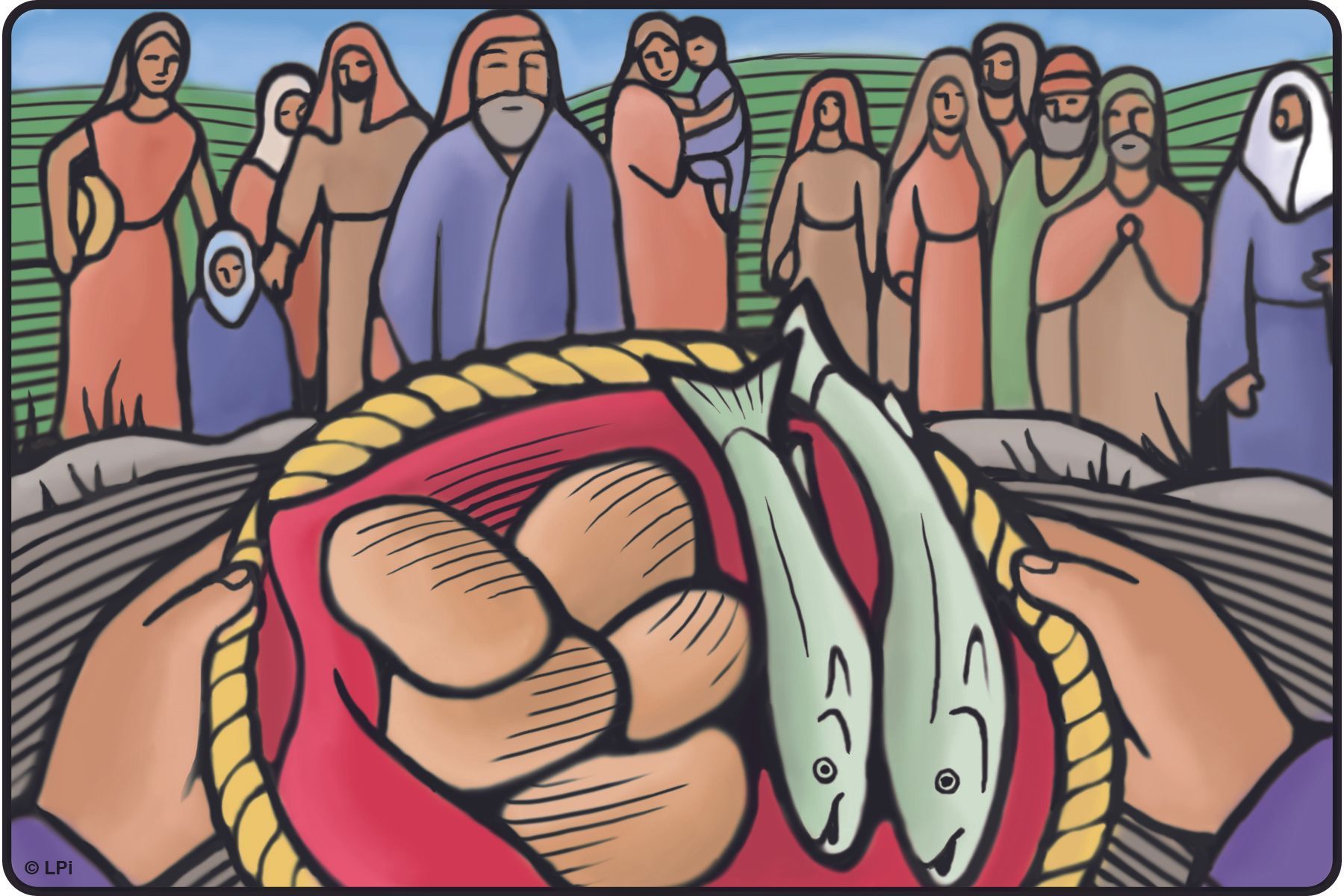
The gospel begins with the words: When Jesus heard of the death of John the Baptist.... John is Jesus’ cousin; John is the one who leaped in his mother's womb when he met Jesus in his mother’s womb. John is the one who baptized Jesus and now Jesus hears that John is dead by being beheaded. Jesus is in grief and wants to be alone. We are told that in his grief, Jesus went off to be alone. Word gets out where Jesus is and all the people show up looking for him to heal and feed them. We are told that Jesus’ heart is full of compassion for the people. Rather than telling them to go away, to let him be, he heals them. This is the life of a disciple – people are not in need on my schedule. When people show up, I need to attend to them. We can never do ministry with our eye on the clock. Although he was tired and in grief, Jesus cared for the people. He knew he could not be there always and his disciples would need to help out. When the disciples tell Jesus the people are hungry, the disciples were the hungry ones. Jesus tells them to give them something yourselves. This is Jesus’ way of calling them to act as disciples. I have fed them with my words; if they need food for their bodies, give it to them yourselves. The disciples find five loaves and two fish. Jesus offers a prayer. Jesus gives thanks for what has been provided, an action of gratitude. He then gives them to the disciples to distribute. Jesus is asking them to continue his ministry by feeding the people. What is left over fills 12 baskets; the number 12 reminds us of the 12 tribes. Jesus has come to feed the whole world. Jesus provides the feast and we as disciples share what we have been given with others. The five loaves and two fish are enough to feed the crowd and provide many leftovers. Our God is a God of abundance. What God has provided is not wasted and what God has provided is given to us by disciples who participate in God’s work. If we are to be disciples, we need to learn how to feed others. Like Jesus, we may find that being a disciple interrupts our life. When someone is in need we attend, we put aside our own agenda for a time and attend to the person in need. Our grief may come later after we care for the person in need. Those who were fed echo the words of Isaiah in the first reading. They come and are fed body and soul. The feeding of the soul are the words of Jesus and the feeding of the body comes from the hands of the disciples.
By Deacon Paul Cerosaletti July 19, 2026
There is a 16-acre field that stretches up behind my house on what used to be my father’s farm. This spring, the farmer that rents that field planted a “new seeding” of alfalfa haycrop, rotating it out of corn production from the previous year. He tilled the soil, carefully incorporating the remains of the previous corn crop, making the ground level. He then rolled it with a large smooth roller to smooth the ground, push down the stones and make a firm seedbed. He seeded the alfalfa, and then rolled the ground again, making sure there was good seed-soil contact, to ensure the alfalfa, which too is the smallest of seeds, would germinate. Then he left the field. And waited. And hoped. And trusted. For the planting of seed is an act of faith.  That field of newly seeded alfalfa behind my house sprang up with great vigor in May and early June. It looked wonderful — a solid stand. The rain in the third week of June benefited the crop as it was getting dry, but brought with it as well a flush of an unwanted crop — weeds! This farming reality mirrors Jesus’s reminder in the parable that with the good seed of God sown and growing, there will always be weeds of the world — be they people, places, or things — that will compete with the growth of God’s Kingdom. In perhaps a surprising twist in the parable, the farmer instructs the laborers not to pull the weeds, lest they uproot the good crop as well. This is an exhortation to trust and patience in the action of God. While weeds can be devastating to a crop, in the Kingdom of God, it's important to remember that these weeds were once sown as good seed. St. Isadore of Pelusium, a fifth-century Desert Father of the Church, taught that God, the Master of the Harvest, is patient , and the weeds are not to be immediately pulled and burned, in order to give time for us to repent and mend our ways, that we might become good grain again. What? Weeds turned into good grain? Impossible, we think? But St. Isadore reminds us, lest we forget, of the striking examples of St. Peter and St. Paul, who strayed in sin, and yet with God’s grace and repentance went on to yield good and abundant fruit. Indeed, this is the story of so many of the saints! Thanks be to God for a merciful Father who “[gives] his children good ground for hope that [he] would permit repentance for [our] sins” (Wis 12:19b) — giving us a chance to become good grain again! One more thing about that field of newly-seeded alfalfa that became full of weeds. It was what we would term a “clear seeding”, which is a seeding solely of the intended principal crop (alfalfa in this case). There is another strategy that farmers employ to manage weeds in a new seeding, which is to plant them with another intended crop, usually a small grain like oats or barley. We call this other crop a companion crop . The companion springs up early and outcompetes the weeds, holding them at bay. Yet, due to its narrow but tall stature, it allows light down into the canopy to nurture the alfalfa. The result is two intended crops that thrive, helping each other yield a valuable and bountiful harvest. This agricultural practice reminds us that we are never Christians in isolation, but are indeed Christians in communion — companions that help each other on the journey towards the eternal harvest. That journey is the journey of holiness. The Church teaches that we are all called to holiness. That is our ultimate state of being for which we each are created. God sows us as companion crops for each other that we might help each other to grow in holiness, helping each other along the way by example and by deeds of love, kindness, and mercy, which sometimes include fraternal correction. Deeds which sometimes are the smallest of seeds, but grow to have the greatest of effect on each other. When we help each other grow in holiness, we fill the world with companion crops, keeping the weeds of the world at bay.
By Rev. Christopher Welch July 12, 2026
We are well into summer. I keep getting shown photos of the gardens people are tending in their backyards. It takes work and patience for produce to grow. Come in a few weeks and we will have a bountiful harvest of all kinds of produce. Those who are farmers can readily understand the parable of the sower in today’s Gospel. God sends out God’s word, and we are to be good soil for the word to take root. The challenge is to become fertile soil for the word of God. How do we become fertile soil? To be fertile ground, we need to keep an open mind. Too often I find myself not listening to what the other is saying, as I compose in my mind a response to what I think I am hearing. To really listen means to keep my mind open to receive what the other is saying. To listen means putting aside my agenda for a time. Sometimes the word of God struggles to get through all the noise in my brain. This is why quiet time in my day is so important; those who wish to listen to the voice of God go to a quiet place to listen for God. In these summer months we will spend time in quiet places where the word of God may speak to us. God’s voice is found at the seaside, in the woods, and on mountain tops. We need to quiet ourselves and listen for God’s voice. Making ourselves fertile ground for God’s word is not easy. We need to each day work to calm ourselves to hear God’s word. St. Ignatius of Loyola suggests a daily examen. Each day as we pray the Examen we become fertile ground. Here is how it is done: How to Pray the Examen Place yourself in God’s presence. Give thanks for God’s great love for you. Pray for the grace to understand how God is acting in your life. Review your day — recall specific moments and your feelings at the time. Reflect on what you did, said, or thought in those instances. Were you drawing closer to God, or further away? Look toward tomorrow — think of how you might collaborate more effectively with God’s plan. Be specific and conclude with the “Our Father.” Each day we work to make ourselves fertile ground.